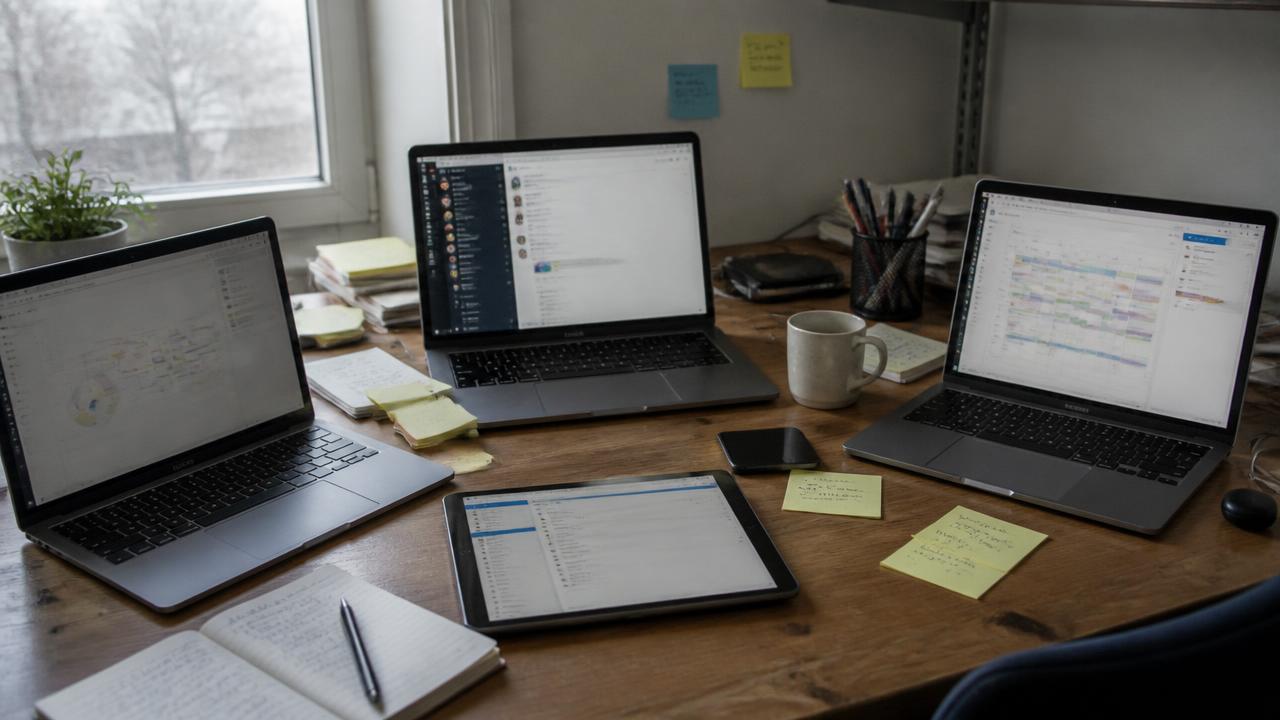
Custom AI Employee for Manufacturing?

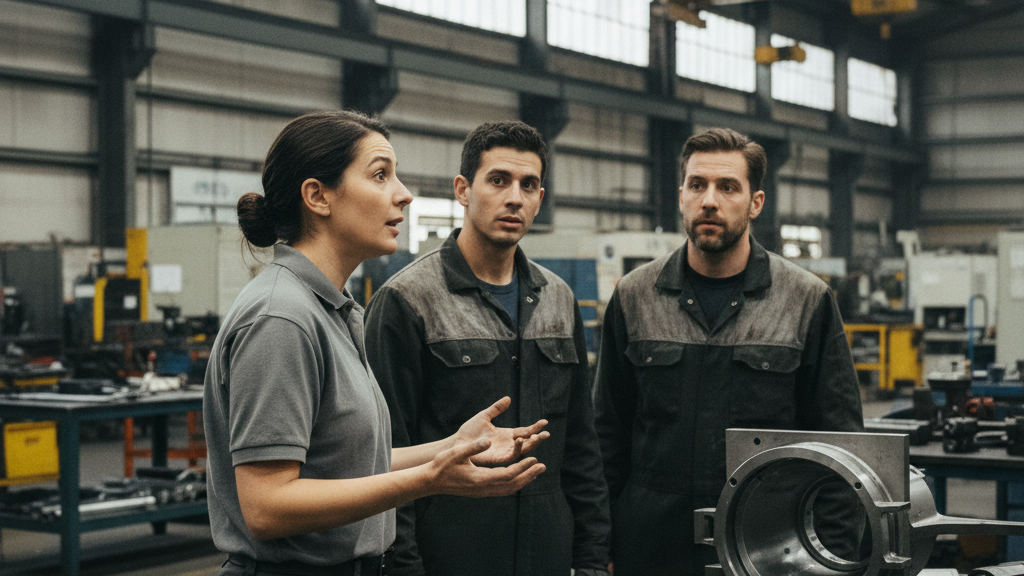
A custom AI employee for manufacturing is a software agent configured to handle repetitive administrative and operational tasks such as procurement, production scheduling, and inventory management. These systems integrate directly with existing ERP and MES software to process data and execute workflows without manual data entry, typically requiring three to six weeks for initial deployment.
On this page
A custom AI employee in a manufacturing context is a digital agent trained to perform specific administrative and coordination tasks previously handled by staff. It functions by accessing your internal data—such as bill of materials, supplier lead times, and machine availability—to provide answers or execute actions like drafting purchase orders. Unlike generic software, these agents follow your company's specific rules for safety, quality control, and vendor selection.
In typical manufacturing workflows, manual data reconciliation between spreadsheets and ERP systems can consume ten to fifteen hours per week per department. A custom AI employee is designed to reduce this administrative load by monitoring these systems. This allows production managers to focus on floor operations rather than clerical work, while reducing the human error inherent in high-volume data entry.
What can a custom AI employee do in manufacturing?
In a manufacturing environment, a custom AI employee serves as an automated coordinator for high-volume information tasks. It can monitor inventory levels against production schedules to identify potential shortages before they stop a line. By the time a human manager arrives on Monday morning, the AI has already drafted the necessary emails to suppliers for missing components.
Beyond simple monitoring, these agents can handle complex documentation tasks. They can draft Technical Data Sheets, process Incoming Quality Control reports, or summarize shift logs into daily executive reports. This ensures that operational knowledge is captured consistently, regardless of which staff members are on the floor.
- Automated procurement drafting based on live inventory levels.
- Translation and formatting of technical manuals for international teams.
- Initial screening of supplier quotes against historical pricing data.
- Summarization of maintenance logs to predict machine downtime.
More on this: What does an AI employee cost — and what does a human one really cost?
How much does a custom AI employee cost?
The cost of a custom AI employee is determined by the complexity of the process it manages and the number of systems it must access. A single-process agent, such as one that only monitors inventory, has a lower entry point than a cross-departmental agent that coordinates between sales orders and production floor capacity. Most projects are structured as an initial configuration fee followed by a monthly maintenance and hosting cost.
Maintenance is necessary because the underlying data structures and software APIs in a factory often change. Regular updates ensure the AI continues to read your ERP data correctly even after a software version upgrade. Companies should budget for both the initial build and the ongoing technical oversight required to keep the agent aligned with operational changes.
Do not automate processes that are currently in flux; AI requires a stable, documented workflow to be effective.
More on this: Why 14 AI tools change nothing — and one system changes everything
What is the implementation process for manufacturing AI?
The process begins with a technical audit of your current data silos. We identify where your production data lives—whether in SQL databases, Excel files, or common ERP environments. Once the data sources are identified, we build a secure bridge that allows the AI to read this information without compromising the integrity of the original records.
After the bridge is built, we define the 'operating procedures' for the AI. This includes the logic it must follow, the tone it uses in communications, and the specific triggers that require a human to take over. We then run the agent in a 'shadow mode' for one to two weeks, where it generates outputs for human review before it is allowed to send any external communications.
When should you not use AI in manufacturing?
AI employees are not a substitute for physical safety inspections or critical engineering decisions. If a task requires physical intuition or complex spatial reasoning on the factory floor, it remains a human responsibility. Attempting to automate highly creative or non-linear problem-solving often leads to errors that cost more to fix than the manual labor saved.
Similarly, if your company's data is not digitized, an AI employee cannot function. A custom agent requires clean, accessible digital records to provide accurate outputs. If your production logs are still primarily on paper, the first step is digitizing that workflow rather than deploying an AI layer.
- Tasks requiring physical presence or sensory judgment.
- Highly irregular processes that change every month.
- Environments with no digital record-keeping infrastructure.
- Safety-critical decisions that lack a human-in-the-loop override.
How is data security handled for custom AI?
Security is the primary concern for mid-sized manufacturers with proprietary designs and client lists. DND Systems builds agents where data stays within European-hosted infrastructure, ensuring that your sensitive production data is not used to train public AI models. Every connection between your ERP and the AI agent is encrypted and restricted to specific IP addresses.
Access control is managed at a granular level. You can define exactly which folders, databases, or documents the AI can see. This prevents the agent from accessing sensitive HR or financial data that is not relevant to its specific manufacturing task. Audit logs are maintained so you can see every action the AI has taken and every piece of data it has accessed.
In short
- AI employees operate within existing ERP and MES systems without replacing them.
- Implementation focuses on one specific process, such as procurement or scheduling, to ensure reliability.
- Data privacy is maintained by processing information within European-hosted infrastructure.
- Initial deployment typically takes three to six weeks depending on data accessibility.
How could AI employees be used in your firm or your business?
Send us a brief description of a repetitive task your team handles daily. We will review your workflow and email you a written assessment of the automation potential within two business days.
After 30 minutes you have
A clear yes or no
Whether your task is suited to an AI employee at all.
A real number
What it roughly costs — and what you realistically save.
The first step
Concrete and doable. Even if it happens without us.
AI expert for mid-sized companies
„I can help you move the repetitive work in your company over to AI employees.”
Tell us the task that eats the most time
You do not need to know the technology behind it. Just write, in your own words, what costs you the most time.
What happens next
- 1
We review your task
We check whether an AI employee is worth it for this at all.
- 2
We write back to you
Usually within one business day — short and without obligation.
- 3
30 minutes of clarity
What works, what does not, and what your first step would be.
What happens if you do not switch to AI
Your competitors are switching already.
The majority of companies plan to introduce AI in 2026.
That means up to 30% more margin.
Because AI employees take over the recurring tasks.
Costs drop significantly.
AI works around the clock, needs no holidays and no payroll overhead.
More money is left for marketing.
Saved costs flow into advertising — and bring in more customers.
Customers move to the competition.
More ad budget pulls customers away — and leaves less market for you.
Whoever does not adapt is pushed out of the market.
Over the next two to three years AI becomes the standard for mid-sized companies — not an option.
This is not scaremongering — it is already happening in the first industries. And most companies do not fail because they lack the will, but because they do not know how to walk this path. That is exactly what we show you — and implement for you if you want. We create clarity and we deliver.
Do not put your decision off until tomorrow
One conversation, 30 minutes, free. Afterwards you know which task in your company suits an AI employee — and what the first step is.
No obligation. No lock-in contracts, no sales pressure. Prefer to write? Go to the form