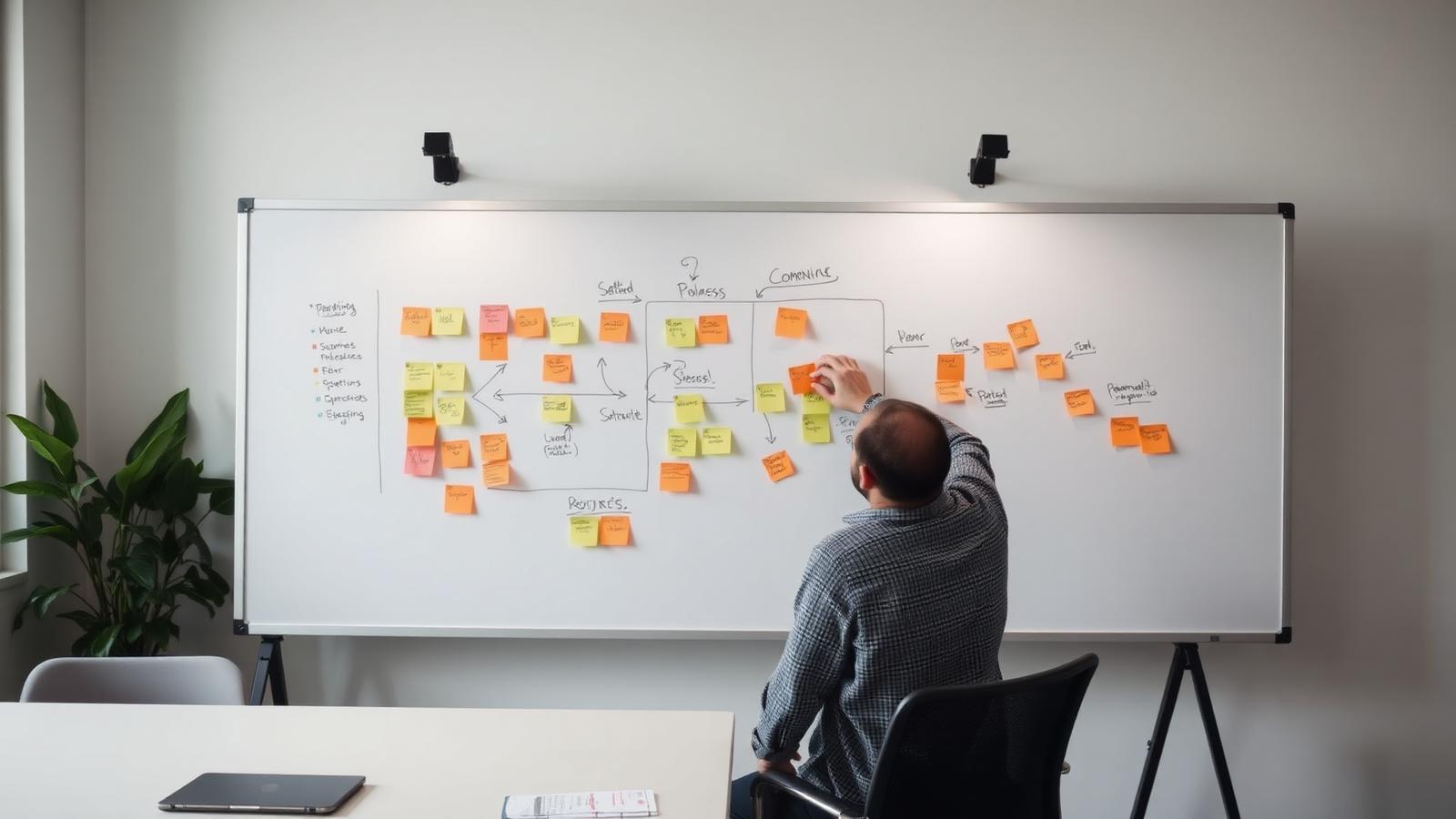
What is a process audit — and why does it come before any software?


On this page
It sounds like consulting theatre. It is the opposite: two to three weeks of concrete work that ends with a document you can act on — or take to somebody else.
What actually happens
We sit with the people who do the work — not only with management — and walk through their day. Which task, how often, how long, from which system to which system, what goes wrong, what the workaround is.
Almost every audit surfaces two or three processes nobody at management level knew existed, usually held together by one person and a spreadsheet.
More on this: How to automate a business process — a practical 7-step guide
What you receive
- A documented map of each recurring workflow, its systems and hand-offs.
- An automation inventory: what can be automated now, later, or never — with the hours attached.
- A target architecture: what the system would look like and how it connects to what you have.
- A costed, staged proposal for the first build, with the expected effect per stage.
The output belongs to you. If you never build with us, you still have the map — and it is useful for any provider.
More on this: How to start with AI in your company — the first 90 days
Why it is not optional
Software built on assumptions about your process is software you will rebuild. The audit converts assumptions into documented facts before anybody spends money on engineering.
It is also the only honest basis for a price. Anyone quoting a full system after a first call is either padding heavily or planning to renegotiate later.
How much of your team's time it takes
Typically a few hours per role across two to three weeks: one workshop, a follow-up conversation, and a review of the written map to correct what we misunderstood.
That review round matters. A process map the team has corrected is a document everybody trusts; one written only by outsiders is not.
In short
- It records how work is really done, not how the manual says it is done.
- Output: process map, automation inventory, costed architecture proposal.
- It is fixed price and self-contained. No obligation to build anything.
- Every serious automation decision needs this input, whoever supplies it.
How could AI employees be used in your firm or your business?
Send us a short description of your operation. We tell you which workflows an audit would measure, and what you get out of it in hours and euros.
After 30 minutes you have
A clear yes or no
Whether your task is suited to an AI employee at all.
A real number
What it roughly costs — and what you realistically save.
The first step
Concrete and doable. Even if it happens without us.
AI expert for mid-sized companies
„I can help you move the repetitive work in your company over to AI employees.”
Tell us the task that eats the most time
You do not need to know the technology behind it. Just write, in your own words, what costs you the most time.
What happens next
- 1
We review your task
We check whether an AI employee is worth it for this at all.
- 2
We write back to you
Usually within one business day — short and without obligation.
- 3
30 minutes of clarity
What works, what does not, and what your first step would be.
What happens if you do not switch to AI
Your competitors are switching already.
The majority of companies plan to introduce AI in 2026.
That means up to 30% more margin.
Because AI employees take over the recurring tasks.
Costs drop significantly.
AI works around the clock, needs no holidays and no payroll overhead.
More money is left for marketing.
Saved costs flow into advertising — and bring in more customers.
Customers move to the competition.
More ad budget pulls customers away — and leaves less market for you.
Whoever does not adapt is pushed out of the market.
Over the next two to three years AI becomes the standard for mid-sized companies — not an option.
This is not scaremongering — it is already happening in the first industries. And most companies do not fail because they lack the will, but because they do not know how to walk this path. That is exactly what we show you — and implement for you if you want. We create clarity and we deliver.
Do not put your decision off until tomorrow
One conversation, 30 minutes, free. Afterwards you know which task in your company suits an AI employee — and what the first step is.
No obligation. No lock-in contracts, no sales pressure. Prefer to write? Go to the form