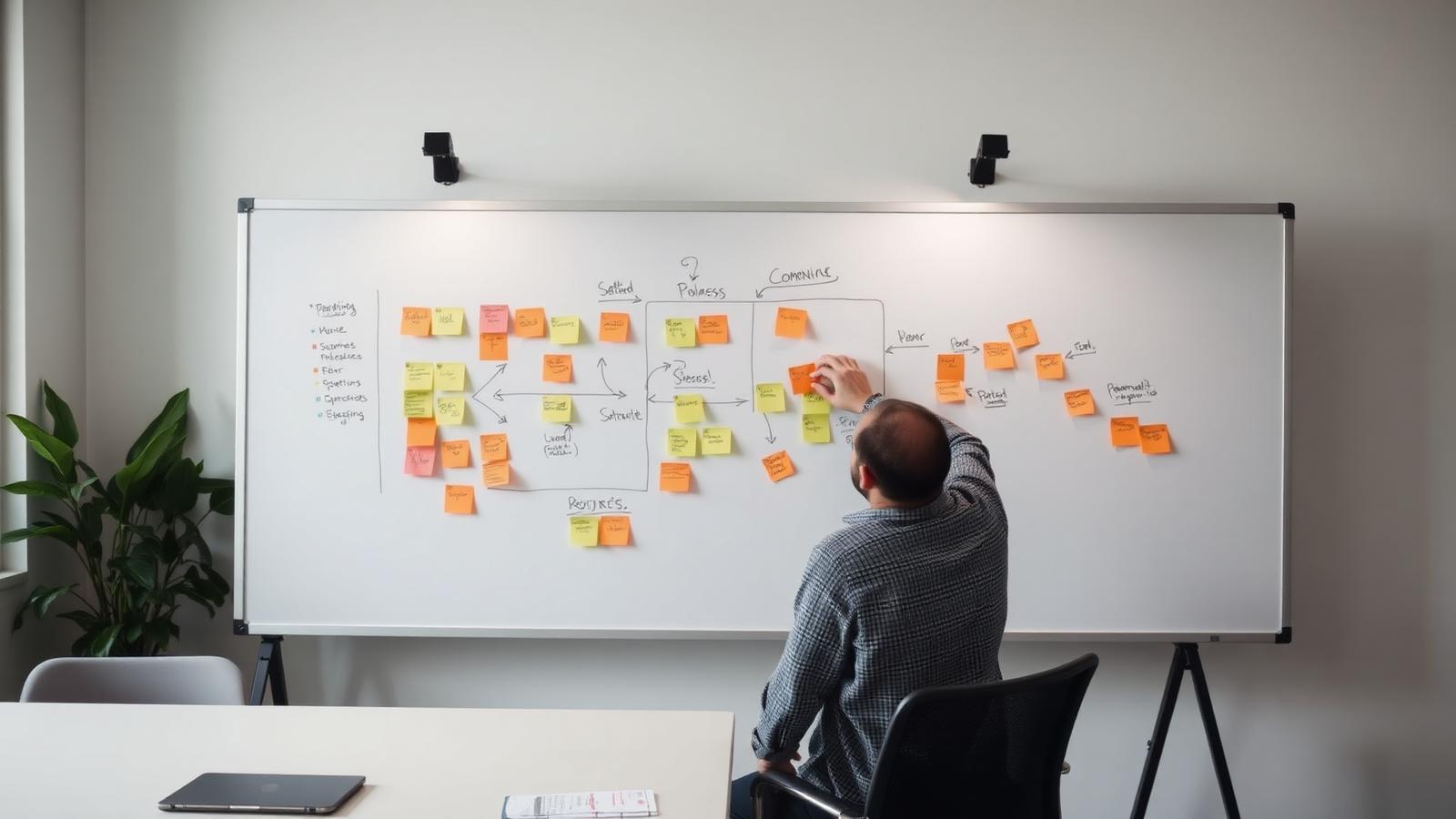
Which tasks can AI actually take over in a company?


On this page
Instead of theory, here is a list you can hold against your own week. If a task on it consumes hours in your company, it is a candidate.
Handled well today
- Reading and sorting incoming email, routing it to the right person or process.
- Extracting data from invoices, delivery notes, contracts and forms — including bad scans.
- Matching invoices to orders and flagging differences.
- Drafting quotes and order confirmations from your price and margin rules.
- Chasing missing documents and unanswered questions until they arrive.
- Preparing recurring reports: monthly settlements, backlog, margin, utilisation.
- Answering repetitive customer questions about status, delivery and documents.
- Keeping master data clean — duplicates, addresses, tax IDs, formats.
More on this: How to automate a business process — a practical 7-step guide
Handled with a human in the loop
These work, but a person approves before anything leaves the building:
- Pricing where discretion or negotiation is involved.
- Customer correspondence in sensitive situations — complaints, delays, disputes.
- Anything with a legal or contractual consequence.
- Payments and bookings above a value threshold you define.
More on this: What is business process automation? Explained with real examples
Not a job for AI
Building trust with a customer. Deciding strategy. Hiring. Judging whether a person is right for a role. Negotiating a contract that matters. Anything that requires being physically present.
Any provider claiming otherwise is selling you a problem for later.
The correct target is not "AI does everything". It is "nobody in this company spends their day retyping data".
The three-question test
For any task, ask: does it happen at least weekly? Could you explain the rules to a new hire in one page? Does it arrive digitally, or could it?
Three times yes means automatable, usually with good payback. Two out of three means it is worth looking at once the obvious wins are done. One or none means leave it alone.
How to find the hours
Most companies underestimate their admin load by half, because it is spread across everybody in fifteen-minute slices. The fastest way to see it is to ask each person to list what they did yesterday in half-hour blocks for one week.
That list, not a vendor's brochure, is the honest starting point for any automation decision — and it is exactly what a process audit produces in a structured form.
In short
- Repetition + written rules + digital input = automatable today.
- Documents, correspondence, reconciliation and reporting are the biggest wins.
- Anything relational, strategic or physical stays with people.
- The three-question test at the end tells you within a minute.
How could AI employees be used in your firm or your business?
Write down two or three tasks from your everyday work. We sort them into automate now, automate later and keep human, with the hours saved for each.
After 30 minutes you have
A clear yes or no
Whether your task is suited to an AI employee at all.
A real number
What it roughly costs — and what you realistically save.
The first step
Concrete and doable. Even if it happens without us.
AI expert for mid-sized companies
„I can help you move the repetitive work in your company over to AI employees.”
Tell us the task that eats the most time
You do not need to know the technology behind it. Just write, in your own words, what costs you the most time.
What happens next
- 1
We review your task
We check whether an AI employee is worth it for this at all.
- 2
We write back to you
Usually within one business day — short and without obligation.
- 3
30 minutes of clarity
What works, what does not, and what your first step would be.
What happens if you do not switch to AI
Your competitors are switching already.
The majority of companies plan to introduce AI in 2026.
That means up to 30% more margin.
Because AI employees take over the recurring tasks.
Costs drop significantly.
AI works around the clock, needs no holidays and no payroll overhead.
More money is left for marketing.
Saved costs flow into advertising — and bring in more customers.
Customers move to the competition.
More ad budget pulls customers away — and leaves less market for you.
Whoever does not adapt is pushed out of the market.
Over the next two to three years AI becomes the standard for mid-sized companies — not an option.
This is not scaremongering — it is already happening in the first industries. And most companies do not fail because they lack the will, but because they do not know how to walk this path. That is exactly what we show you — and implement for you if you want. We create clarity and we deliver.
Do not put your decision off until tomorrow
One conversation, 30 minutes, free. Afterwards you know which task in your company suits an AI employee — and what the first step is.
No obligation. No lock-in contracts, no sales pressure. Prefer to write? Go to the form